Friday, April 3, 2015

the first of several posts on virtual reality suits

From the first book of Sharon of Two Salems, on page 101:
“Here’s the VR suit,” Alice said.
“Where?” Sharon asked.
“It’s invisible—it’s just a force field that wraps around your body. And that section of floor moves in all four directions as you walk on it. It will also tilt and incline with the same angle of the floor the virtual reality robotic form is walking on at that moment. Here, why don’t you try it?”
Sharon steeled herself and gingerly stepped onto the square area. Nothing happened. So far, so good, she thought.
“Now try walking,” Alice instructed.
Sharon took a shaky step forward. The foot behind her slid backward, though, and she found herself in exactly the same place in the center of the panel.
Feeling a little braver, she walked normally. The material of the panel moved right along with her steps, and she stayed exactly in the same place. She even turned a little, and it easily accommodated that movement.
A virtual reality setup that includes being able to walk in place--while the visuals through the glasses show the participant walking to a new location--is in development.
The Virtuix Omni™ evolves virtual reality one step further, allowing anyone to stand up and traverse virtual worlds with the natural use of their own feet. Walking and running in virtual reality creates an unprecedented sense of immersion. 
It will be interesting to see the final product. Here are some more details:
The Omni uses a concave platform that enables a smooth, natural gait and an immersive walking and running motion. Comfortable Omni shoes allow for extended gameplay and fast-paced battlefield action. A robust support ring and unattached support harness provide maximum safety and versatility for rapid, unconstrained movements. Walk, run, jump, and turn swiftly and smoothly in 360 degrees without restraints. 

 In Sharon of Two Salems, force fields surrounding the body provide the "safety net" so that the person in the suit can't fall off of the panel. However, we're still a ways from creating something remotely like a force field, much less one that would cushion up gently to one's arms and legs. 

It will be interesting to find out how the safety features on the Omni work to prevent falling, including the "unattached support harness," as they get ready to roll out this product. 

Thursday, April 2, 2015

A vacuum for radioactive emissions?

On page 120 of the second volume of Sharon of Two Salems:
She looked down at her robotic form, and it had no colors emanating from it to the orb. Her form could function in close proximity to the sphere because it depended on plain old electricity to run. That part still didn’t make sense to Sharon. If the orb was vacuuming up something as powerful as radioactive emissions, why weren’t the lesser forms of electromagnetic radiation being sucked up, too? However, this was a good thing; their electrically powered robotic forms wouldn’t function if the orb suddenly started absorbing regular old electricity as well.
The assumption in this paragraph is that there could be some undiscovered field of physics that would allow for radioactive emissions pouring in all directions from a source to be somehow deflected or "bent"...without affecting other forms of electromagnetic radiation. Also the assumption is that the orb absorbing the radioactivity wouldn't affect physical matter, either.

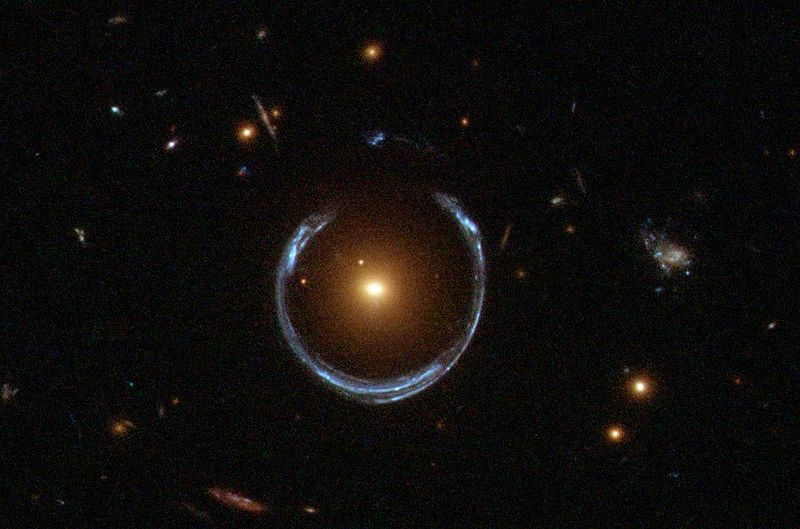
It is know that very heavy objects in deep space (such as a compact cluster of galaxies) can cause a phenomenon called "gravitational lensing." The light from objects behind the heavy mass is actually bent as it passes by. To us here on Earth, looking through our telescopes at places in space this is occurring at results in us seeing a visual distortion of the object behind. Here's a classic example:
Strong gravitational lens LRG 3-757
From Wikipedia:
What's large and blue and can wrap itself around an entire galaxy? A gravitational lens mirage. Pictured above, the gravity of a luminous red galaxy (LRG) has gravitationally distorted the light from a much more distant blue galaxy. More typically, such light bending results in two discernible images of the distant galaxy, but here the lens alignment is so precise that the background galaxy is distorted into a horseshoe -- a nearly complete ring.
The "orbs" in Sharon of Two Salems have been written to be about as big as a super large beach ball. If something that size could not only bend rays of radioactivity but suck them into itself as well, it would be more powerful than the strongest gravitational lenses we can see in space. Remember, we can still see the objects behind the "lenses"--but in the story, the radioactivity is completely diverted to the orb and consumed by it (the latter will be a topic for a future blog post).

The orb would have to be gravitationally more powerful than the largest objects (or clusters of objects) in space, yet smaller than a car. In this universe, I (the author) have to admit that's physically impossible. Not only would radiation be swept up into it, but light and physical objects as well. In fact, it would be a black hole...easily sucking up the entire earth, all the other planets and their moons, and the sun. It's "event horizon" would extend well beyond the reaches of the Kuiper Belt, and it would probably consume those space rocks as well.

But it is fiction we're talking about...I just haven't thought of a good MADE-UP way to explain it...

Tuesday, March 31, 2015

Computerized glasses?


“Nothing.” Sharon focused once more on the names of stores and roads that floated by in the field of vision of her new glasses. “Are these like those prototype glasses Google is working on?”

And then a little later, the sound in them is explained to Sharon:

“Your glasses are also stereo speakers, specifically they are located in the temple arms.”
However, she suffers from sensory overload after wearing them for a while:
Sharon had her glasses off to rest her eyes from the multitude of words that hovered over the buildings, streets, and stores in the area.    
Now back to real life. "Google Glass" is the prototype that Google has been working on for quite some time. 


(Google Glass logo)

This Wikipedia article has a good summary of the research and development. This is where the state of the project stands currently:
According to Google, Project Glass was ready to "graduate" from Google Labs, the experimental phase of the project.[BBC reference]
The device is currently not available for sale, but Google remains committed to developing the next model. 

The main concerns that have been raised about Google Glass relates to privacy, since they are...and new models will continue to be...capable of recording video and sound. I'm not going to discuss that here, since some of the characters in my novel  had violated a great deal of privacy by hacking into people's personal computers and into some of the most powerful computers in the world, by this point in the story (I may discuss that particular subject in a future post).

As I wrote my novel and tried to imagine what wearing glasses like these would be like, it occurred to me how distracting it could become if too much information was visible in one's field of vision. After a while, I added the feature of my fictional version of the glasses having voice control to turn off some of the features. 

Nevertheless, the problem remains one of distraction. Walking could be problematic if one is reading information off of their glasses. True multi-taskers are rare, and we've all experienced what it's like talking to someone who's on facebook or texting and not REALLY listening...

Questions I still have about Google Glass:

  1. Is the text and imagery that's projected onto the glass always in focus for the wearer? For example, if their eyes focus on something a few inches away and then suddenly on the sunset, does the focus of the projected imagery remain clear and readable?
  2. Are there already apps for Google Glass that allow names of locations to "hover" over them as the wearer physically approaches these places?
  3. (a fun question) Can interactive games be designed that would allow projected animations on the glass "react" to things the viewer sees in his or her field of vision?